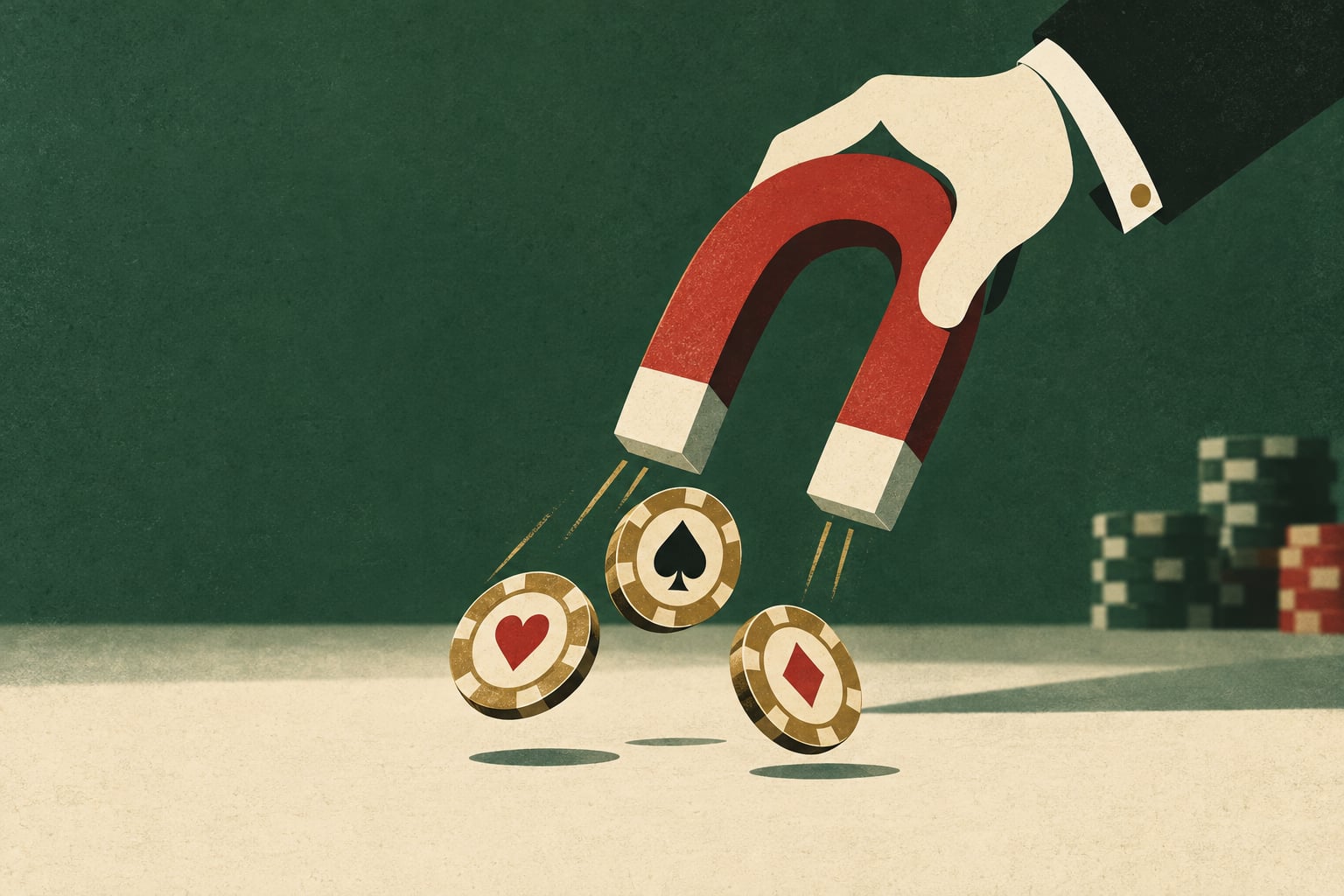
Call a low-stakes game “soft” and what people usually mean is that three or four players see most flops for the minimum. That table isn’t soft because those players are bad postflop, though most of them are. It’s soft because they keep putting money into the middle without claiming anything in return, and somebody at the table is going to collect it. The question is whether that somebody is you.
Raising over limpers is the least glamorous edge in poker. It requires no read, no timing tell, no clever line. It’s a mechanical adjustment: when weak players enter the pot passively, you enter it aggressively, and you do it with a size that reflects how badly they’re going to play the rest of the hand. Solvers have almost nothing to say about it, because solvers assume an opponent who never limps in the first place. That’s precisely why the edge survives.
What follows is the arithmetic, the hand selection, and the handful of spots where the standard advice gets you stacked instead of paid.
What you’re actually buying when you raise over a limp
Take a $1/$2 game. Two players limp in front of you. Before you act, there’s $7 in the pot: the two blinds and two limps. You raise to $12 from the cutoff.
If everyone folds, you win $7 and you risked $12 to do it. That’s a breakeven fold requirement of about 63 percent, which no limpy low-stakes table is going to give you. The raise is not a bluff, and it doesn’t have to work outright.
Say one limper calls and the blinds go away. Now there’s about $29 in the pot, you have position, and your opponent has a range that cannot contain aces, kings or most of the hands that beat you. He told you that when he limped. You bet $9 on the flop, a third of the pot, and that bet only needs to work a quarter of the time to break even on its own. Against a player who limped 72 suited and flopped nothing, it works far more than a quarter of the time.
That’s the actual product you’re buying. Not immediate folds, but a heads-up pot, in position, against a range with a ceiling on it, where your continuation bets are cheap and your opponent’s calling decisions are hard.
Why the old “three big blinds plus one per limper” rule outlived the theory that killed it
The rule of thumb predates solvers by twenty years and it’s still roughly right, for a reason that has nothing to do with game theory. Bigger raises against limpers are correct because limpers call too much, not because they fold too little.
With one limper in a $1/$2 game, that means raising to around $10 to $12 in position. With two limpers, $14 or so. Out of position, add another big blind or two, because you’re going to face more decisions and want fewer opponents making them with you. These are large by online standards. They should be.
The mistake is treating the sizing as a lever for fold equity. It isn’t, mostly. If a player limp-calls 80 percent of the time regardless, your extra big blinds are pure value: you’re building a bigger pot with a hand that’s ahead of his range and a positional edge he can’t neutralize. Against a calling station, sizing up is a value bet made before the flop.
The genuine exception is the table where a big raise gets three callers anyway. If your $14 routinely goes four ways, you’re not isolating, you’re sponsoring a multiway pot with a hand that wanted to be heads-up. On that table, sizing bigger again doesn’t fix it. Tightening your isolation range does.
The hands that isolate well, and the ones that only look like they do
The instinct is to isolate with anything that beats a limping range, which is most of a deck. That’s too loose, because you’re not just claiming equity, you’re claiming a hand you can bet three streets with.
Big broadway hands and suited aces are the core. Ace-queen, ace-jack, king-queen and any suited ace make strong top pairs, flop good draws and dominate the ace-rag and king-rag hands limpers refuse to fold. Offsuit hands in the ace-nine to ace-jack range are fine against one limper in position and get thin against two, because the second limper’s range is more likely to contain the aces that beat yours.
Suited connectors are the ones people misplay. Seven-six suited is a wonderful hand to see a cheap multiway flop with, and a mediocre hand to build a $30 pot with heads-up against a station. It makes second pair and then has nowhere to go. Raise them selectively, against opponents who fold on the flop, and be happy taking the free look otherwise.
Small and medium pairs sit in the middle. Against one limper with 100 big blinds behind, raising sixes is fine. With three limpers and shallow stacks, the set-mining math starts to favor seeing a flop cheaply, and flat-calling behind a limper is one of the few times the limp-call has a defense. Pocket pairs want implied odds. Broadway hands want fold equity and a heads-up pot. They are not the same plan.
The players left to act decide more than your cards do
Your raise happens with people behind you, and that’s where isolation plans go to die. The limper is passive by definition. The button, the small blind and the big blind are not.
If there’s a competent, aggressive player still to act, your isolation raise is a target. He knows you’re widening against limpers and he can re-raise with impunity, because you can’t credibly continue with ace-nine and a $14 investment. Against that player, either tighten into hands that can call a re-raise or accept that you’ll fold the weak part of your range and fold it cheerfully.
The big blind matters in the opposite direction. He’s already in for two dollars and he’s getting a decent price to see a flop out of position. If he’s the sticky recreational type, your heads-up isolation often becomes a three-way pot with the worst opponent in the wrong seat. That’s not a disaster, but it changes your hand selection. Hands that make top pair get worse three-handed. Hands that make nuts get better.
And then there’s the limper who limps intending to raise. He exists, more at $2/$5 than at $1/$2, and he’s usually holding aces or kings. The tell is almost always positional: an early-position limp from a player who otherwise opens every pot. Two data points are enough. Once you’ve seen a player limp-raise once, discount your isolation range from that seat by a wide margin.
Where the whole adjustment stops applying
Straddled pots are the first exception. When there’s a live straddle on, a limp is no longer a weak player’s tell. It’s often a reasonable stack-preservation play from someone facing an inflated blind. The pot is bigger, the effective stacks are shallower in big-blind terms, and your isolation sizing has to grow so much that you’re committing a third of your stack to win dead money. Tighten sharply.
Short stacks are the second. Raising to $12 to isolate a player with $40 behind gives you almost no postflop room to use your positional edge. You’re effectively playing a preflop all-in with the worst of the dead money already claimed.
The third is the assumption that limping means weakness at all. It doesn’t in short-handed and heads-up play, where limping the button is a legitimate strategy and pots get contested with real ranges. Back in August, Lucas Jumalon took a meaningful pot with middle pair in a non-raised preflop hand during his heads-up match with Lauri Saaskilahti at the 2026 WSOP Main Event. Nothing about that spot resembles a $1/$2 table where four players call the minimum in front of you.
The flop is where the raise gets paid off
Isolating and then giving up on the flop with anything other than top pair is how players convince themselves this adjustment doesn’t work. The raise is only the setup.
Heads-up in position against a limper, on a board with high cards, bet small and bet often. A third of the pot is plenty, because his range is full of weak pairs and complete air, and he has no flush-and-straight-heavy hands to fight back with. If he calls and the turn bricks, fire again at a larger size. Limp-callers fold turns at a rate that would embarrass them if they saw the numbers.
Multiway is where you slow down. Three opponents, one continuation bet, and no read is a recipe for donating. Check back and take a free card with your marginal hands.
Comments
One response to “Isolating Limpers: A Preflop Edge for Low Stakes”
[…] an argument for attacking, not for posting. The straddled pot rewards the player who isolates limpers with an appropriate raise, and the correct raise is bigger than the one you’d make […]